

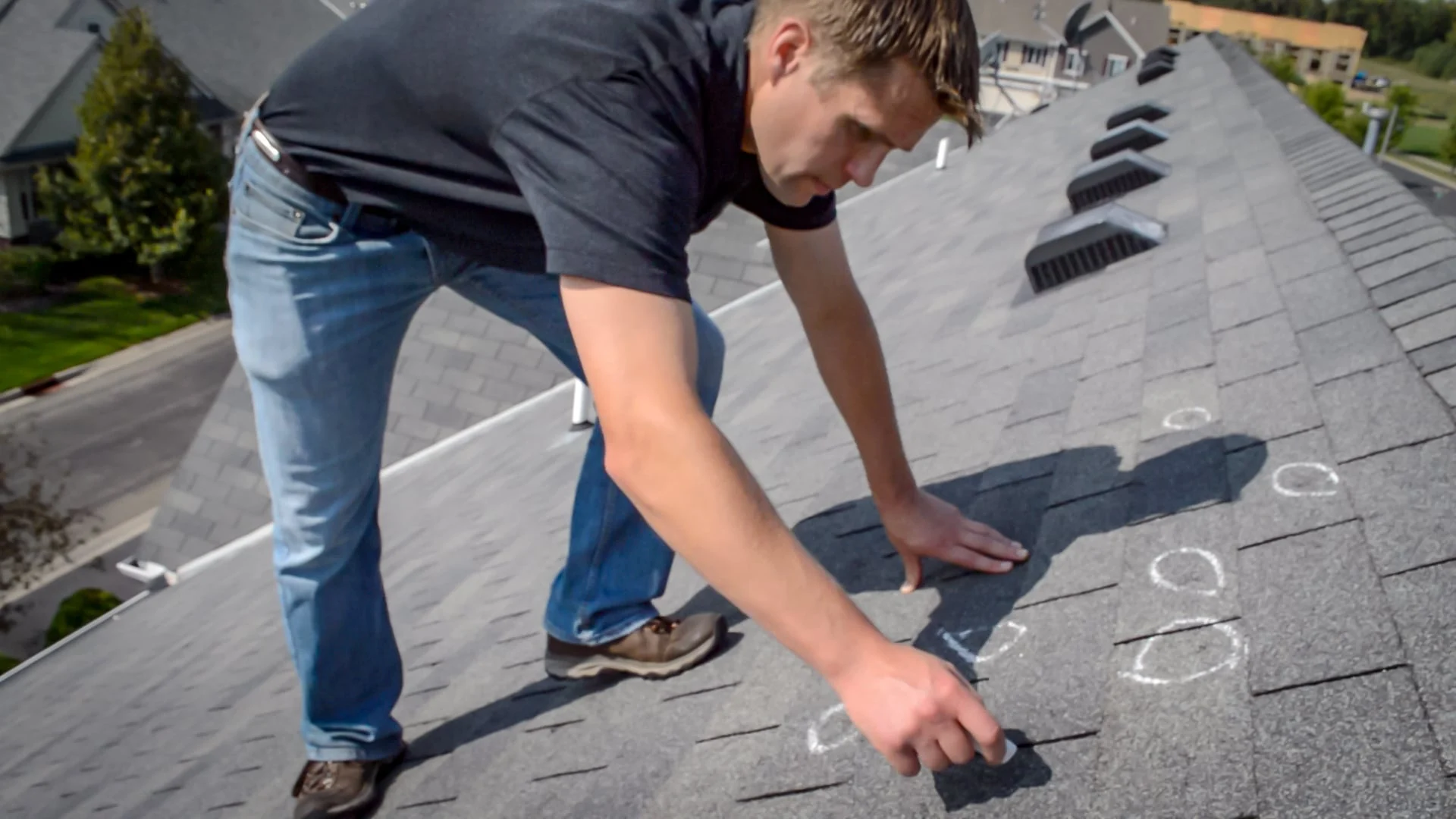
Spring and summer convective storms move through the Inland Northwest most years, and some of them carry hail large enough to mark up a low-slope commercial roof even when the ground-level damage looks minor. The trouble with a hail claim on a flat roof is that the evidence does not announce itself the way a shattered windshield does. It has to be found.
Built-up and modified bitumen roofs, still common on older buildings around downtown and the University District, show hail damage as bruising: soft, compressed spots where the impact has crushed the felt layers or displaced granules from the cap sheet without necessarily punching all the way through. From a standing walk, bruising can look almost identical to normal weathering, which is why we work the field methodically rather than scanning for obvious holes.
Single-ply membranes such as TPO, EPDM, and PVC react differently. Hail impact on those systems can leave dents that telegraph through the membrane, splits at brittle or aged sections, or fractured seams where the impact concentrated stress on a weld. On rooftop equipment, coping, and edge metal, dents and cracked or chipped paint are usually the clearest, fastest-to-photograph sign that a hail event actually occurred on that roof, even before we assess the membrane itself.
When damage is subtle enough to be in dispute, we lay out a test square: a defined area where we count and photograph every strike, giving the adjuster a measurable hail density instead of a general impression. On roofs where the impact may have compromised the membrane down to the substrate, a core cut confirms what a surface inspection alone cannot.
Rooftop mechanical equipment across Spokane's growing medical and biotech campuses, and the large flat membrane fields on warehouse and distribution buildings along I-90, both carry a lot of exposed surface area for a hail event to strike. On those larger roofs, we sample multiple sections rather than relying on a single test square, because hail density is rarely uniform across an entire building.
The core problem with hail claims on commercial roofs is timing. Granule loss and minor bruising blend into ordinary aging the longer they sit undocumented, and a roof inspected months after an event can present a much weaker case than one inspected within days. We recommend getting a hail-suspect roof documented as soon as reasonably possible after a storm, well before the damage has a chance to be reasonably attributed to wear instead of the weather event.
A note on our role: we are your roofing contractor, not a public adjuster. We inspect, document, and substantiate the roof damage with photos, measurements, and moisture data so you and your insurance adjuster are working from the same accurate scope. Filing the claim and negotiating the settlement stay between you, your broker, and your carrier.
Hail Claim Questions
Does hail actually damage a flat commercial roof, or just siding and cars?
Yes. Hail can bruise or fracture the surface of a modified bitumen or built-up membrane, dent metal coping and rooftop equipment, and crack aged single-ply membrane, even when the damage is far less obvious than the dented cars and cracked windows people notice at ground level first.
Why do hail claims on commercial roofs get denied or underpaid more often than other perils?
Hail damage on a low-slope membrane rarely looks dramatic. Bruising can be subtle, granule loss on a cap sheet can resemble ordinary aging, and without a close, hands-on inspection an adjuster working from a drive-by report or a photo can easily undercount what is actually there.
What does hail damage look like on different roof systems?
On built-up or modified bitumen roofs, look for bruising, cracked or displaced granules, and soft spots. On single-ply membranes like TPO or EPDM, hail can leave dents, splits, or fractured seams. On metal coping, flashing, and rooftop units, dents and cracked paint are usually the clearest sign an event occurred.
Do you use test squares or core cuts to document hail damage?
When the damage is subtle enough to be in question, yes. A test square lets us document the density and pattern of hail strikes in a defined area, and a core cut can confirm whether an impact has compromised the membrane down to the substrate, both of which give the adjuster a defensible basis for the scope.
Is there a time limit for filing a commercial roof hail claim in Washington?
Policies vary, so the filing deadline in your specific policy governs, but hail damage that is left undocumented for an extended period becomes harder to distinguish from ordinary weathering. Getting the roof inspected promptly after a hail event protects the claim regardless of when you ultimately file.