

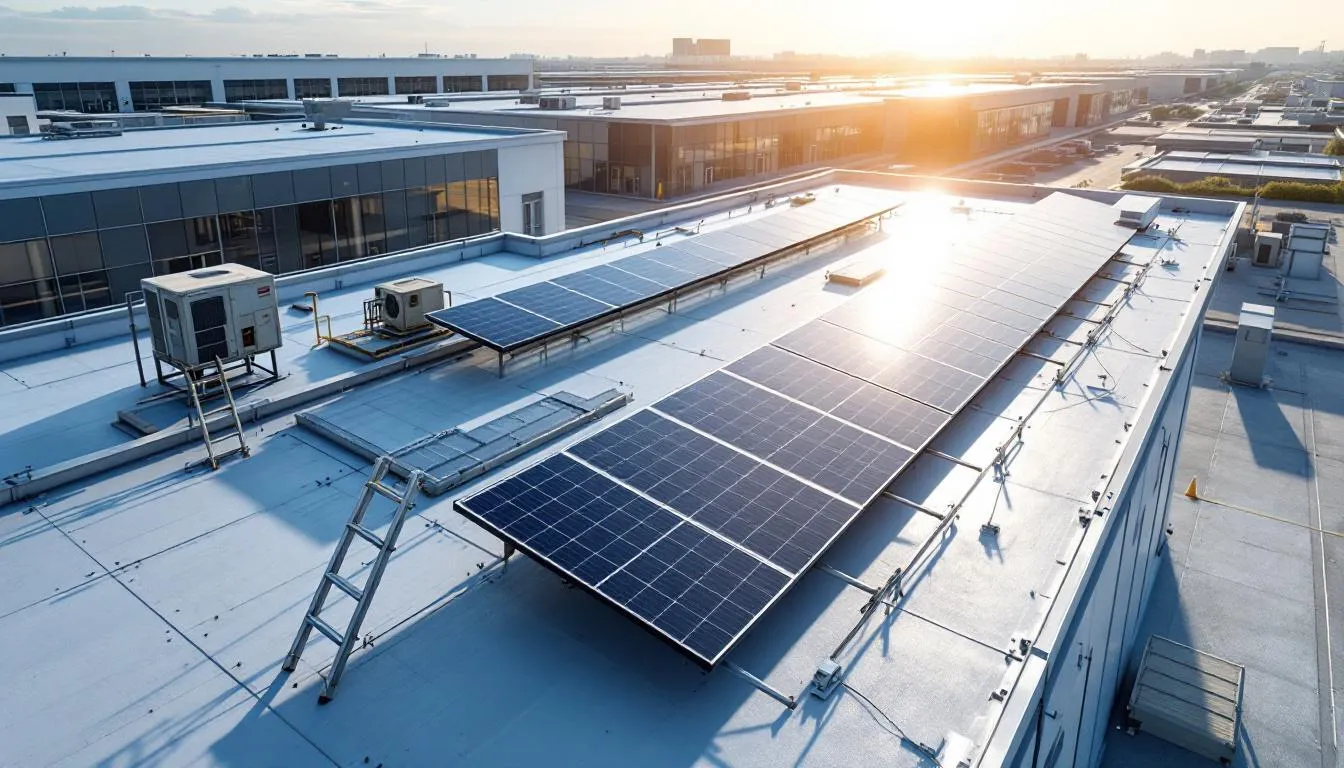
The thing that makes industrial flex roofing its own discipline is how much the roof changes over time without anyone roofing it. One building might house light manufacturing, a distribution hub, a contractor's shop, and a lab tenant across subdivided bays, and the mix turns over with each lease. Every one of those tenants adds or removes rooftop HVAC, cuts new penetrations for power and ductwork, and parks equipment up there that was never in the original loading plan. By the time we walk a flex roof in Spokane, it's carrying years of undocumented modifications. So every flex scope we do starts with a penetration survey, not because anyone cut corners, but because the property records never kept up with the roof.
Spokane has a deep flex inventory and it's spread across the usual corridors. The Spokane Valley industrial park along Sullivan Road and Trent Avenue, the large business park north of I-90 with well over a hundred resident companies, is full of multi-tenant flex, and so are the East Trent blocks, the Liberty Lake business parks near the Idaho line, and the West Plains buildings out by the airport. The construction ranges from 1970s tilt-wall with built-up roofing to modern pre-engineered metal buildings, and the right approach depends entirely on which one is in front of us.
Many Penetrations, Many Tenants, One Roof
A multi-tenant flex roof is a field of curbs, vents, and conduit runs serving different bays, and that density is where leaks start. We photograph and map every penetration, compare it to the original drawings when they exist, and flag the non-standard or poorly sealed ones for remediation before any new membrane goes down. That survey is also what prevents warranty fights later, a penetration somebody added after the fact shouldn't become an argument about who owns the leak.
Spokane Snow Plus Flat Bays Plus Tired Drains
Most flex buildings are low-slope, and low-slope plus Spokane's snow load plus aging drainage is a recurring problem. Ponding sits over the bays, drains clog with debris faster in the bays nobody is watching, and freeze-thaw works at every seam and flashing all winter. On tilt-wall and concrete flex our standard is 60-mil TPO mechanically attached over new polyiso, with tapered insulation where the field has gone flat, so water actually clears to the drains before it freezes. For buildings with heavy rooftop equipment or a lot of HVAC-contractor foot traffic across multiple tenants, stepping up to 80-mil TPO or fully adhered 60-mil PVC buys real puncture and traffic resistance.
Pre-Engineered Metal Buildings Are a Different Animal
A good share of newer Spokane flex is pre-engineered metal with standing seam or R-panel roofs, and those don't get treated like a flat membrane roof. Depending on panel condition, purlin spacing, and load capacity, a metal roof recover, silicone-coated metal or a retrofit standing seam system, can extend service life without a full tear-off. We evaluate recover against full replacement honestly and install both, so the recommendation fits the building rather than whatever's easiest to sell.
A Maintenance Program Beats a Crisis on a Multi-Tenant Roof
Flex buildings are the property type where a small maintenance budget pays for itself fastest, because the failure mode is rarely one dramatic blowout, it's a slow accumulation of clogged drains, lifted seams at a tenant's old penetration, and a soft spot over the bay that's been vacant for a year. By the time a tenant calls about a ceiling stain, water has usually been in the assembly for months. We set up scheduled inspections that clear the drains before each Spokane winter, recheck the penetrations after any tenant move-in or move-out, and catch lifting flashings while they're still a caulk-gun fix instead of a tear-out. For an owner carrying several flex properties, that turns the roof from an unpredictable emergency line item into a planned, budgeted asset.
Vacancy and Lease Transitions Are When Roofs Quietly Fail
Flex roofs take on water during turnover. When a tenant leaves and their HVAC units come off, the open curbs often get a temporary cap that fails within a rain event or two, and vacant bays collect debris that blocks drains. For owners and property managers, a lease-transition roof check should always confirm curb-cap status, verify former-tenant penetrations are properly sealed, and clear the drains. We provide standardized condition reports across a portfolio so capital planning for multiple flex properties runs off the same yardstick.
- Start with a photographed penetration survey before any membrane work.
- Remediate non-standard and poorly sealed tenant penetrations up front.
- Use tapered polyiso to clear ponding before Spokane winter freezes it in place.
- Evaluate metal-roof recover honestly against full replacement on pre-engineered buildings.
- Check curb caps, sealed penetrations, and drains at every lease transition.
Industrial Flex Space Roofing Questions
How do you handle undocumented tenant penetrations?
Tenant-improvement penetrations on flex buildings are usually missing from the records, so our pre-project survey photographs and maps every penetration, compares it to the original drawings where they exist, and flags any non-standard or improperly sealed ones for remediation before new membrane goes down. That heads off warranty disputes after completion.
What membrane is best for a multi-tenant flex building?
Sixty-mil TPO mechanically attached over tapered polyiso is the common, cost-effective choice for tilt-wall and concrete flex in Spokane. For buildings with high rooftop-equipment density or heavy multi-tenant service traffic, 80-mil TPO or fully adhered 60-mil PVC is worth the added cost for its puncture and traffic resistance.
How do you coordinate work across tenants with different schedules?
We start from a bay-by-bay occupancy map and lease-contact list from property management, identify which bays have active rooftop equipment and which are vacant, and note tenants sensitive to noise or HVAC downtime. Sequencing and daily dry-in are coordinated through the property manager, tenants get advance notice but communicate through management, not directly with the crew.
How do you price flex roofing for owners and managers?
Per roof square, based on membrane spec, existing assembly condition, penetration density, and bay configuration, with fixed-price proposals after a roof walk and core sample where needed. Portfolio owners get standardized condition reports they can use for capital planning across multiple properties.
Do you work on standing seam metal flex roofs?
Yes. Pre-engineered metal buildings get evaluated differently, depending on panel condition, purlin spacing, and load capacity, a silicone-coated metal recover or retrofit standing seam system can extend life without a full tear-off. We spec and install both recover and full replacement in Spokane.