

An airport never closes, and that single fact reshapes everything about how its roofs get replaced. There's no after-hours when the building goes dark, no weekend when the gates empty out. Every access point, material lift, and crew deployment has to be cleared with the facilities department, fit inside the airport's Part 139 safety program, and in places get past TSA security before anyone sets foot on the roof. We work that coordination into the scope before the contract is signed, because on a live airfield the planning is the job, the membrane is the easy part.
Spokane International Airport sits on the West Plains just west of the city along Interstate 90, the busiest airport in Eastern Washington and the air gateway for the whole Inland Northwest, with passenger service from the major carriers and a growing air-cargo operation feeding the region's distribution hubs. A few miles farther west is Fairchild Air Force Base, home to a major Air Mobility Command refueling wing and the Air Force's survival school, and on the east side of the city Felts Field handles general aviation. Together they make this a dual commercial-and-military aviation market, and a cold, snowy one, where winters demand systems that shed snow and shrug off freeze-thaw without splitting.
What Makes a Terminal Roof Different
Terminal roofs are large, flat, and low on slope, which puts drainage front and center and leaves almost no room for ponding tolerance. They also carry far denser and heavier mechanical equipment than a comparable office or logistics building, more curbed penetrations, more flashing touchpoints, more places to get a detail wrong. On airside roofs there's jet blast to contend with, which means membrane adhesion and ballast have to be specified well beyond what you'd use on a warehouse of the same size. We document every penetration, curb height, and clearance in a pre-project survey and engineer the oversized-curb and through-penetration details individually rather than reaching for a standard pattern.
The Whole Campus, Not Just the Terminal
An airport is a small city of buildings, and most of our aviation work is on the structures around the terminal: cargo facilities, rental-car centers, FBO and maintenance hangars, and the hotels that sit on or beside the campus. The building types vary, but the access rule doesn't, badging and escort requirements apply across the property, and field crews plan for them up front instead of discovering them at the gate.
Hangars and General Aviation
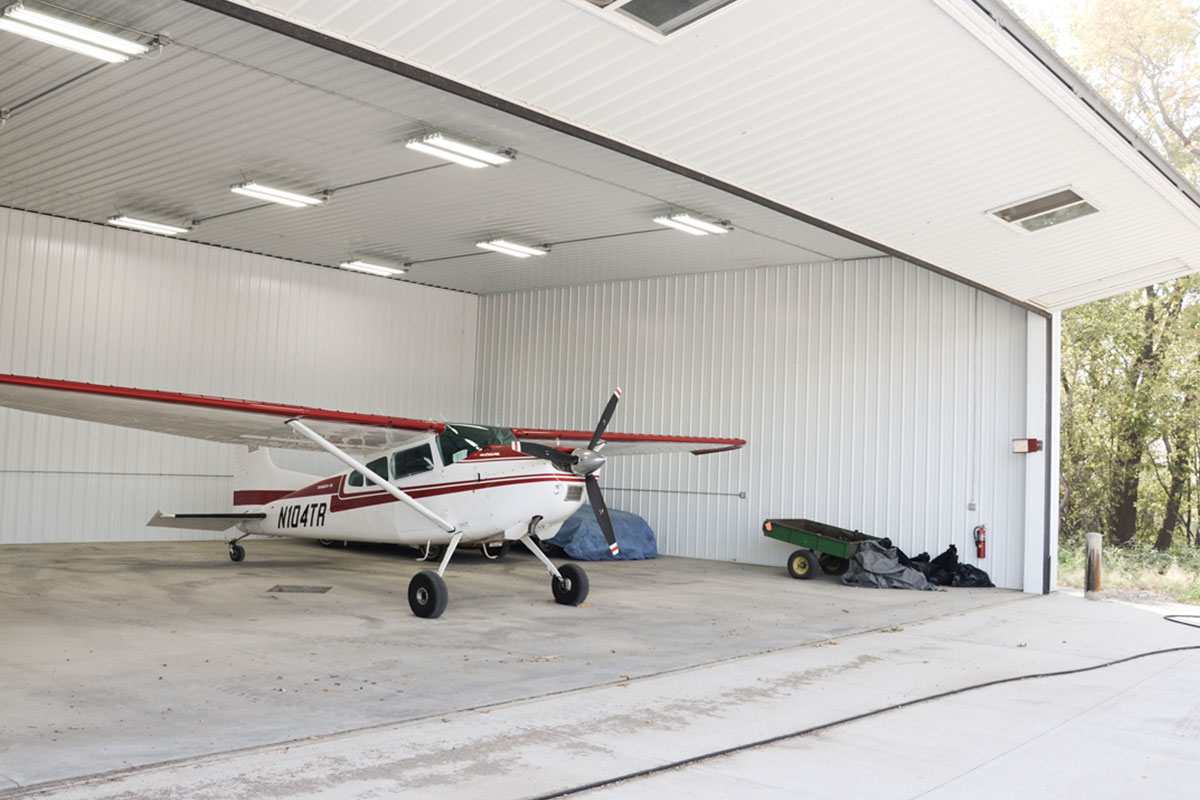
High-bay hangars are their own structural problem. Wide clear-span steel and pre-engineered metal buildings generate serious wind uplift, and the fastening pattern and seam geometry have to be designed for those loads, not borrowed from a low-rise commercial roof. At reliever fields like Felts Field the security protocols ease up, but the buildings are often more demanding than the terminal itself. We spec and install those systems across the region, on single private hangars and multi-bay FBO complexes alike.
How we run an aviation roofing project
- A phased work plan developed with the facilities department and the Part 139 coordinator, with NOTAM coordination where required.
- Material deliveries and crane lifts scheduled into approved windows around airfield operations.
- Crew badging and airside credentialing confirmed before mobilization, no exceptions.
- Tapered insulation and aggressive drainage detailing on flat terminal decks to eliminate ponding.
Acres of Roof, and the Energy That Rides on Them
Terminals and cargo buildings put acres of membrane over conditioned space, and at that scale the color of the roof stops being cosmetic and starts showing up on the utility bill. A reflective single-ply or cool-roof surface knocks down the summer heat gain across a huge footprint, easing the load on the dense rooftop HVAC that already works hard at a terminal. In the Inland Northwest the calculation has two sides, you want reflectivity in summer without giving away too much in a long, cold winter, so we right-size the insulation alongside the surface choice rather than chasing reflectivity in isolation. On roofs this large, even a modest per-square-foot improvement in the assembly's thermal performance compounds into real money, and it's a natural time to plan conduit and structural support for future rooftop solar while the roof is open. We bring those options to the facilities team as part of the spec conversation, not as an upsell after the fact.
Systems Built for the Inland Northwest
For most terminal and support-building reroofs we work with TPO or PVC single-ply over a tapered insulation system that improves drainage and addresses ponding; for new high-bay hangars, standing-seam metal is often the right call. The final spec depends on the existing deck, its load capacity, and the operational constraints of working on a live field, which is why we develop it after walking the roof with your facilities engineer rather than off a catalog. Across every part of an airport campus, the constants are the same: meticulous coordination, watertight daily dry-in, and details engineered for the equipment and the weather they actually face.
Airport & Aviation Roofing Questions
How do you handle scheduling at an operational airport like Spokane International?
We develop a phased work plan with the facilities department and the Part 139 coordinator, approved by airport operations. Deliveries, crane lifts, and any work near airside areas go into approved windows and are coordinated through the NOTAM process where required. It's a standard part of our project setup, not an exception.
What roof systems are standard for large-span terminal roofs?
Most terminal reroofing uses TPO or PVC single-ply over tapered insulation to improve drainage and address ponding. New high-bay aviation structures and hangars are often standing-seam metal. The choice depends on the existing deck, load capacity, and operational constraints, we develop the spec after walking the roof with your facilities engineer.
How do you deal with the density of HVAC and mechanical penetrations on terminals?
Terminal HVAC density runs well above standard commercial. Our pre-project survey documents every penetration, curb height, and clearance before we build the work plan, and oversized-curb and complex through-penetration flashings are engineered individually rather than using standard patterns.
Can you work on airside structures near active runways and aprons?
Yes, with appropriate badging and in full coordination with airfield operations. Airside work takes a higher level of pre-planning and crew credentialing, which we build into the bid timeline. We do not mobilize crew without confirmed airside authorization.
Do you handle hangar roofing for FBOs and general aviation?
Yes. General-aviation hangar roofing, single-bay private hangars through multi-unit FBO complexes, is a regular part of our work. High-bay hangars with wide-flange steel or pre-engineered systems need contractors who understand their uplift and thermal-movement behavior, and we spec and install accordingly.