

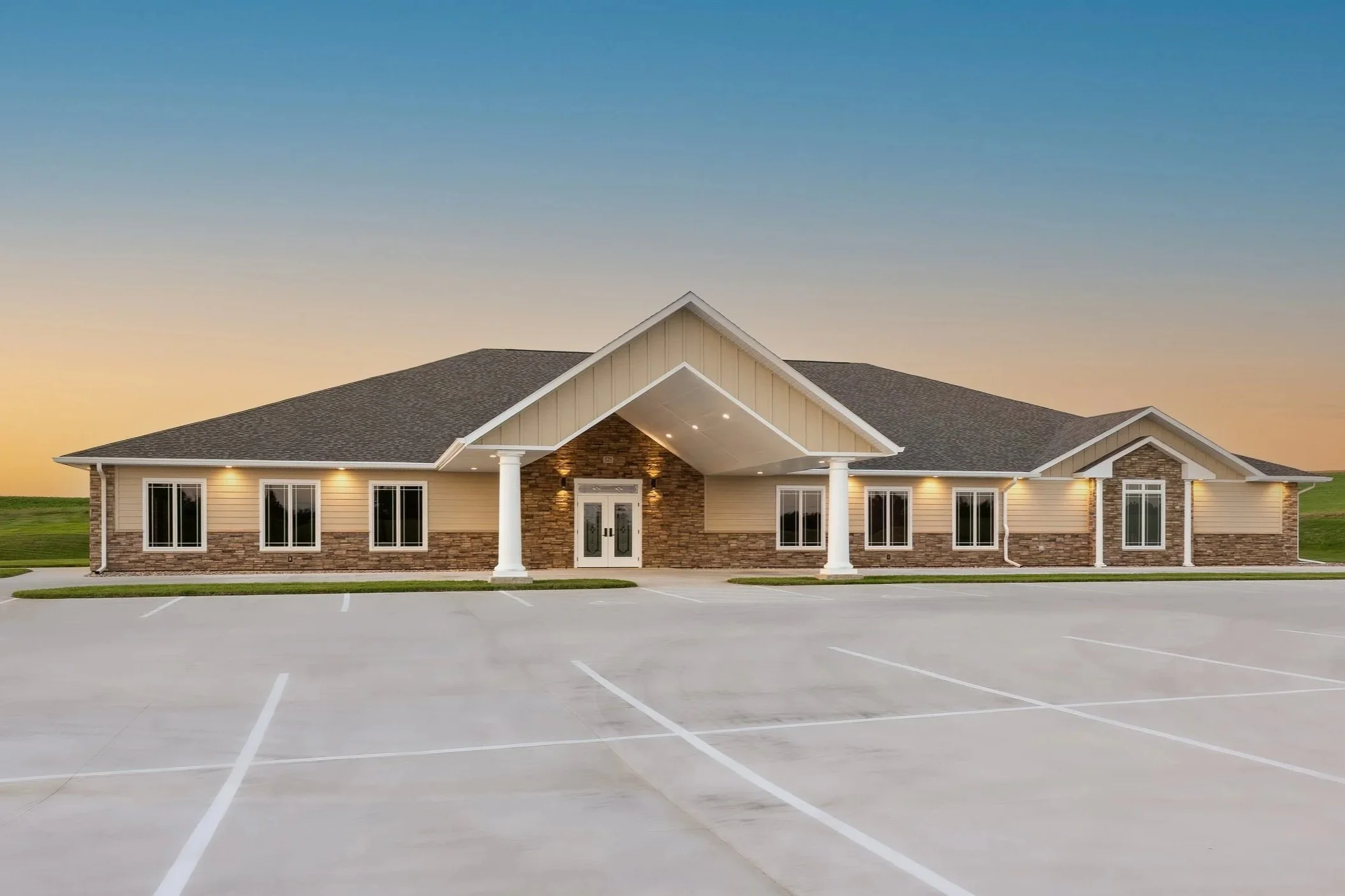
A funeral home is the rare commercial building where the roof crew has to be invisible. Families arrive grieving, services run on a calendar nobody can move, and the last thing a director needs is a hammer drill running over the chapel during a we'd treat work over an occupied surgical suite: quiet, scheduled to the hour, and watertight before we leave each day. Spokane's established funeral homes sit in some of the city's older fabric, along Monroe Street on the lower South Hill, near the medical district by Sacred Heart, and out along Sprague through the Valley, and many of those buildings carry decades-old roof assemblies that need a careful hand rather than a fast tear-off.
Spokane is the hub of the Inland Northwest, the second-largest city in Washington and the seat of Spokane County, which means the funeral homes here serve a regional population that stretches well into North Idaho and the Palouse. That steady demand keeps these facilities in near-constant use, and it's why we plan the whole job around the visitation and service schedule before we order a single roll of membrane.
The Prep Room Changes Everything
The embalming and preparation room is what separates a funeral home roof from any other small commercial building. That space runs under negative pressure to contain formaldehyde and other chemical vapors, and the rooftop exhaust serving it has to stay live the entire time we're on the roof. We locate that exhaust stack on day one, treat it as its own flashing scope, and confirm with the director that it keeps running while we detail around it. Capping it for convenience is never on the table, it's a worker-safety and code issue, and on a building this sensitive we'd rather build a temporary work island around the stack than interrupt it for an hour.
The vapors that stack carries are also hard on roofing materials over time. Around prep-room and restroom exhaust we lean toward stainless flashing and chemically compatible sealants rather than mill-finish aluminum that corrodes early. It's a small detail that shows up years later as the difference between a clean penetration and a rusty, weeping one.
Chapels, Canopies, and the Quiet Front of the Building
Many Spokane funeral homes pair a low-slope flat roof over the offices and prep areas with a wider clear-span chapel that can run forty to sixty feet without an interior column. Those spans behave like a small church sanctuary under wind uplift, so we verify the deck type and pull-test fasteners before we commit to an attachment pattern. Get the fastening wrong on a long span and you get flutter, seam stress, and premature failure.
The porte-cochere, the covered drive where families are received, is its own recurring trouble spot. The flashing where that canopy meets the main wall sees thermal movement and slight settlement, and it's one of the most common chronic leak points we find on these buildings. We scope it as a separate line item rather than assuming a new field membrane will fix a transition detail it was never going to touch.
Appearance Matters as Much as Performance
A funeral home's roofline and front facade are part of how families judge whether the place is well cared for. Streaked fascia, sagging gutters, or a visibly patched roof edge sends the wrong message at the worst possible moment. When we re-roof we pay attention to the visible edge metal, the gutter lines, and any roof element that reads from the parking lot, because dignity here isn't just about the service inside, it's about a building that looks composed.
How we keep the work respectful
- We get the director's service and visitation calendar in advance and sequence loud work into open windows only.
- Staging, dumpsters, and material lifts go to the back of the property, away from the receiving entrance and family parking.
- Every work area is dried in and watertight before the building closes for the evening.
- Crews keep noise down near chapel and visitation spaces and clear those areas entirely during active services.
Family-Owned and Corporate Facilities Alike
Some Spokane funeral homes are multi-generational family businesses; others are part of regional groups run through a corporate facilities desk. Either way the constraints are the same, a building that has to function on short notice, a regulatory environment around the prep room, and a standard of discretion that's higher than almost any other property type. We give both kinds of owners a single point of contact, a written daily dry-in confirmation, and a closeout package with the permit, the manufacturer warranty, and a roof diagram for the file.
Funeral Home & Mortuary Roofing Questions
How do you work around funeral services and visitation schedules?
We start from the director's weekly calendar. Loud tear-off and fastening are sequenced into open windows, and active service or visitation areas stay clear of crews and equipment during those hours. Each day's work area is confirmed watertight before the building closes, and we never stage equipment at the family receiving entrance.
How do you handle the preparation room exhaust stack?
It stays running the whole time. We locate the prep-room exhaust before mobilizing, treat it as a separate flashing scope, and confirm continuous operation with the director for any work near it. It is never capped or blocked for roofing convenience, that's a safety and code requirement, not a preference.
What membrane system do you specify for a funeral home?
For the flat office and prep areas we typically specify a 60-mil TPO or PVC over tapered polyiso so drainage is corrected and ponding is eliminated. Over a wood-decked chapel we confirm load capacity first, then set insulation thickness and attachment to suit the span. The right system depends on what the roof walk and any core samples reveal.
Do you handle the chapel or sanctuary roof span?
Yes. Clear-span chapel roofs are fastened like a small church sanctuary. We check the deck type and span, pull-test fasteners or get structural documentation, and set the attachment pattern to the actual uplift loads rather than a generic detail.
Can you re-flash the porte-cochere and covered entry canopy?
Yes, and we recommend looking at it on every job. The canopy-to-wall transition and the canopy drainage are evaluated as discrete items because they're a frequent chronic leak source on funeral homes and won't be solved by the field membrane alone.