

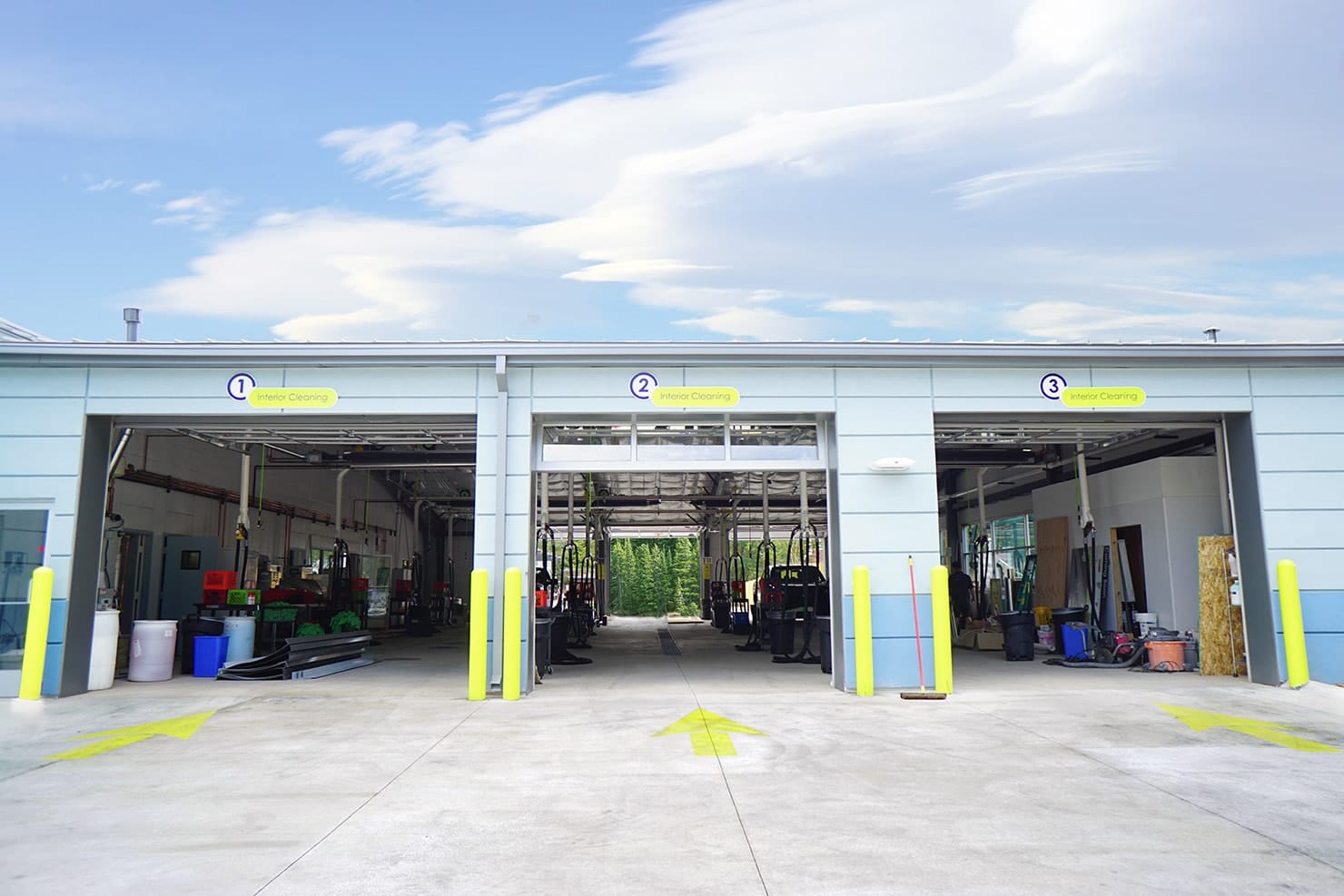
A car wash is one of the few commercial buildings where the roof gets attacked from the inside. Every cycle in the tunnel throws hot water, detergent mist, tire-shine solvent, and wax aerosol into the air, and that warm, chemically loaded vapor rises straight to the underside of the deck. Steel deck and fasteners corrode from below while the topside membrane still looks fine. We've walked plenty of Spokane wash roofs that passed a curb-level glance and were quietly rusting through where nobody looks. That interior-vapor problem is the thing we design around first on any wash here.
Spokane runs a dense car-wash market along a handful of recognizable corridors. Express tunnels and in-bay autos cluster on North Division Street, the Sprague Avenue retail run through Spokane Valley, and the newer commercial pads off Sullivan Road and Indiana Avenue near the Spokane Valley Mall. Out on the West Plains near Geiger Boulevard and along the US-2 / Newport Highway stretch on the north side, fuel-and-wash combos keep going up next to convenience stores. Each of those build types puts a slightly different load on the roof, and we scope them differently.
Tunnel Bays Are the Hardest Roof Zone, Not the Whole Building
The enclosure directly over the active wash equipment is where most of the trouble concentrates. You've got near-constant humidity, alkaline detergent particulate in the air, and thermal swing from hot-water blasts cycling all day. TPO and EPDM both struggle long-term against the alkaline chemistry of commercial wash soaps; the surface chalks, seams get brittle, and adhesion at flashings lets go. For tunnel bays in Spokane we lean toward 60-mil PVC, fully adhered, because its plasticizer chemistry holds up far better to the detergent and wax exposure that shortens the life of other single-plies. Before we commit to anything, we want to know the actual chemical menu the operator is running, because the right membrane depends on it.
Adhesion matters as much as the sheet itself. In a humid tunnel, a vapor-charged deck can defeat a mechanically attached system from underneath, so we usually specify fully adhered assemblies over the bays to kill membrane flutter and to keep the fastener count down in the zone that sees the worst corrosion.
Spokane Winters Stack a Second Problem on Top of the First
Now add the climate. Spokane sees real snow load and long freeze-thaw stretches from November into March. When you trap all that tunnel humidity under an under-insulated or vapor-open assembly and then drive the outside surface below freezing, you get condensation inside the roof and ice damming at the eaves and scuppers. The fix is a proper vapor retarder and an insulation package detailed for our winters, not a warm-climate detail copied off a Sun Belt wash. We size insulation and the vapor strategy for Spokane's actual temperature swing so the dew point lands where it should, in the insulation, not on the steel.
Vacuum Canopies and Pay Stations Have Their Own Failure Points
The vacuum islands and entry canopies on an express wash are usually metal or EPDM-clad and live a completely different life than the tunnel roof. They take vehicle exhaust, overspray from tire dressing, UV all day, and the freeze-thaw cycle outdoors. The transition where a canopy meets the main building, and the canopy's own drain connections, are the single most common chronic-leak source we find on Spokane express washes. We treat canopy roofs, gutters, and those building transitions as their own scope item rather than folding them into the main-roof number.
The Equipment Room and Office Get the Worst of Both Worlds
Tucked beside the tunnel, the equipment and mechanical room is where reclaim tanks, pumps, the boiler, and chemical totes live, and the air in there is warm, damp, and chemically loaded just like the tunnel. The roof over that room sees the same interior vapor attack on the deck plus the heat the equipment throws off, and it's easy to under-build because it's a small area nobody thinks about. The customer office and pay-station roof, by contrast, is dry inside but small and surrounded by penetrations, so its weak point is flashing detail rather than vapor. We don't apply one spec across the whole footprint, the tunnel, the equipment room, the canopies, and the office each get the assembly the conditions under them call for, which is the difference between a wash roof that lasts and one that's patched every spring.
How We Approach a Wash Roof Here
- Confirm the chemical program in use before specifying any membrane over the tunnel.
- Probe the deck from below where access allows, looking for the corrosion that interior vapor causes.
- Detail the vapor retarder and insulation for Spokane's freeze-thaw and snow load, not a generic spec.
- Oversize and individually flash every exhaust-fan and steam penetration above the tunnel.
- Inspect drainage above lower-volume in-bay and self-serve bays, where ponding is the usual culprit.
- Scope vacuum canopies, customer canopies, and their building transitions separately.
Car Wash Roofing Questions
What membrane do you specify over a Spokane wash tunnel?
Sixty-mil PVC, fully adhered, is our default over the tunnel bay because PVC resists the alkaline detergents and wax compounds that degrade TPO and EPDM. Fully adhered installation also eliminates the membrane flutter and fastener field that a vapor-charged tunnel deck works against. For the dry portions of the building, equipment room, lobby, vacuum canopy, a mechanically attached TPO or PVC is usually appropriate.
Why does the deck rust if the roof isn't leaking?
Because the moisture is coming from inside. Tunnel humidity and chemical vapor rise to the underside of the deck and condense there, corroding steel and fasteners from below with no topside leak. That's why we look under the deck and why we detail the vapor retarder and insulation specifically for the interior conditions a wash creates.
Does the warranty cover chemical exposure?
Most standard single-ply warranties exclude chemical attack. Before we spec anything over a tunnel we confirm with the manufacturer that the facility's actual chemical program is compatible with the membrane and that the installation conditions are covered. Some manufacturers offer chemical-exposure or wash-specific warranties, and we identify those during specification.
Can you work while the wash stays open?
Yes, with sequencing. Most Spokane washes run seven days a week, so tunnel-roof work is planned for the early-morning or late-evening close window, and external building and canopy work happens during business hours with traffic control that keeps vehicles clear of the crew.
Do you handle the vacuum canopies too?
Yes. Vacuum island covers, customer canopies, the gutters and downspouts on them, and the canopy-to-building transitions are all part of our wash roofing assessment. Those transitions are usually where the chronic leaks start, so we evaluate and re-flash them as their own scope item.