

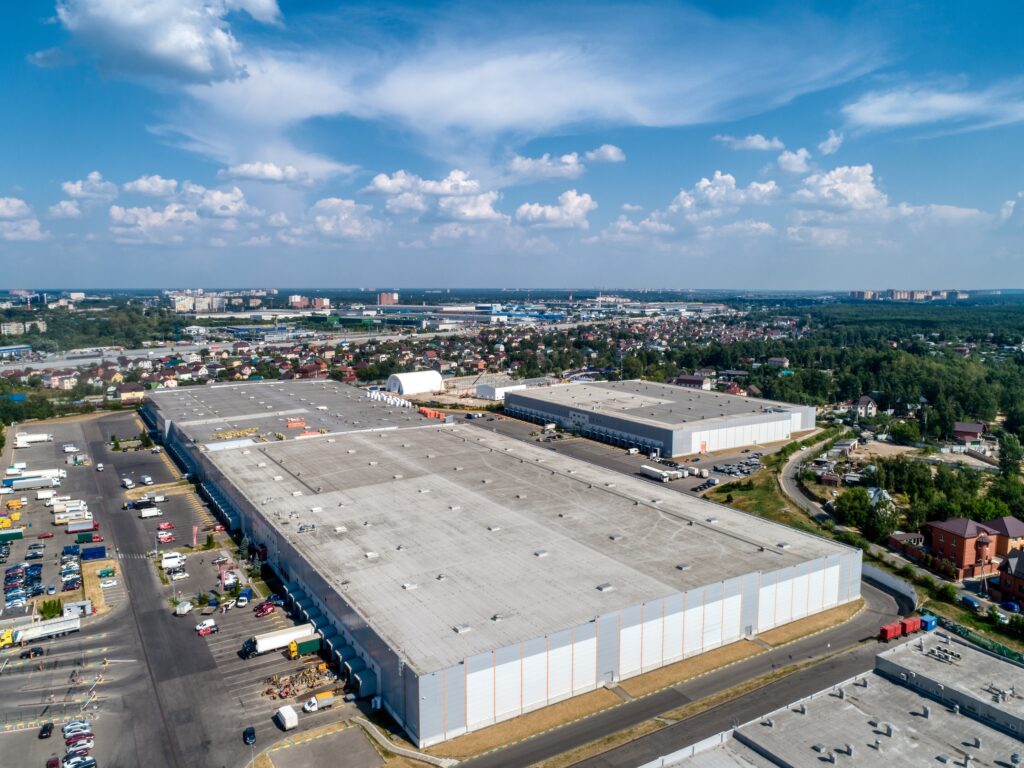
Amazon's BFI4 delivery station and several large Inland Empire warehouse complexes along the Valley Corridor near Sullivan Road represent the growing industrial base that has made Spokane one of the fastest-growing logistics markets in the Pacific Northwest. Unlike its coastal counterpart in Seattle, Spokane operates in a semi-arid continental climate that swings from 100°F summer days to sub-zero winter nights, producing a freeze-thaw profile closer to the northern Midwest than to the Seattle waterfront. Warehouse roofing in Spokane has to handle both of those extremes, along with a wildfire smoke season that deposits fine particulates on roof surfaces from July through September.
Freeze-thaw cycling in Spokane is more intense than in Seattle precisely because the inland climate produces larger daily temperature swings. Seattle rarely gets truly cold; Spokane regularly records overnight lows in the single digits in January and February, followed by daytime highs in the upper 20s or 30s. That 20-to-30-degree daily swing, repeated fifty or more times per winter, stresses every penetration flashing, seam edge, and parapet cap in ways that a coastal climate never does. EPDM has traditionally been preferred by Spokane contractors for this reason, and we maintain that EPDM fully adhered or mechanically attached remains the most reliable choice for Inland Empire warehouse roofing, its elasticity accommodates the thermal movement that cracks rigid or semi-rigid materials.
Snow load on the Spokane Plateau is significant in heavy years. The city's ground snow load under ASCE 7 is 25 pounds per square foot, and warehouses near the Spokane Valley's northern edge, which receive more orographic snowfall than the downtown area, may see drift loads well above the ground snow figure. We review structural calculations before specifying any new roof assembly that adds dead load, and we flag conditions where additional load might push a building close to its design limit. Roof drain sizing for Spokane has to account for rapid spring snowmelt events, particularly in March and April when warm Chinook winds can melt a foot of rooftop snow in 48 hours and overwhelm drains sized only for rainfall intensity.
TPO is increasingly specified on new Spokane warehouse construction, particularly for tilt-up concrete facilities in the Valley Corridor where reflective roofing reduces cooling loads during hot summer months. White TPO on a Spokane warehouse can reduce peak roof surface temperatures from 160°F on a black surface to 110°F, which meaningfully lowers the cooling demand in a building that typically isn't air-conditioned throughout its warehouse bay. Washington State Energy Code requirements apply in Spokane, requiring continuous insulation R-values appropriate for Climate Zone 5, currently R-25 minimum, which means re-roofing projects almost always trigger an insulation upgrade on older buildings.
Wildfire smoke season is a Spokane-specific roofing maintenance issue that has become more significant over the last decade. Fine particulate matter from regional wildfires settles on roof surfaces during July, August, and September, forming a carbon-based film that retains moisture and can accelerate algae and moss growth. While Spokane doesn't have Seattle's chronic biological growth problem, the combination of wildfire deposit season and fall rains creates conditions for accelerated biological colonization on membranes that don't receive annual cleaning. We include a post-smoke-season roof cleaning in annual maintenance agreements for Spokane warehouses, typically scheduled for early October before the fall rain begins.
Dock penetrations at Spokane distribution facilities face a specific condensation risk that's different from coastal markets. Spokane's dry winter air, heated inside a distribution center to 50 or 60°F, has a much lower humidity than the same air would in Savannah or Tampa. When this relatively dry warm air meets a cold metal penetration flashing at the parapet, condensation is actually less severe than in a humid coastal climate. However, the extreme cold-to-warm temperature differential does cause thermal movement in metal flashings that sealant-only terminations cannot accommodate. We use mechanical fastening at all penetration flashing terminations, with sealant as a secondary measure, the opposite of the approach that a humid-climate-focused contractor might bring to a Spokane project.
Forklift exhaust management at Spokane warehouses is particularly important during the summer months when the city's clean air regulations are most actively enforced. Spokane County clean air regulations, administered by the Spokane Regional Clean Air Agency, limit visible emissions from industrial sources, which technically includes heavy forklift exhaust. While rooftop ventilation isn't typically what the agency is targeting, facilities with older propane-powered fleets can benefit from optimizing their exhaust ventilator placement and capacity to minimize ground-level re-entry of combustion products during inversions. We coordinate with the facility's operations team on ventilator placement before finalizing roof curb locations.
Energy performance on a Spokane warehouse is worth investing in because the city's combination of hot summers and cold winters means a well-insulated roof pays dividends in both directions. Summer cooling loads are significant from June through August when temperatures regularly exceed 90°F, and winter heating loads are substantial from November through March. The Washington State Energy Code's R-25 minimum for Climate Zone 5 is a initial benchmark, not a target, we model the payback period for R-30 and R-35 assemblies on every Spokane project and find that the additional insulation above code minimum typically pays back in three to five years through reduced HVAC operating costs.
Long-term durability in Spokane's continental climate requires attention to UV exposure that Seattle contractors may underestimate. Spokane averages over 170 sunny days per year, significantly more than Seattle's 150, and the high-altitude Plateau location means UV radiation intensity is measurably higher than at sea level. UV degradation of elastomeric sealants around penetrations and at flashing terminations happens faster in Spokane than in western Washington. We specify UV-stable silicone sealants rather than polyurethane at all exposed locations and include sealant inspection and recoating in annual maintenance agreements, which prevents the slow leak that starts at a cracked sealant joint and creates a large interior damage claim two years later.
- Is EPDM or TPO better for a Spokane warehouse?
- Both work in Spokane's climate. EPDM has better cold-temperature elasticity history in the region, which matters for freeze-thaw performance at penetration flashings. TPO offers reflective surface benefits that reduce summer cooling loads, which is a growing priority as Spokane summers get hotter. The choice should be made based on the specific building's use, the HVAC load profile, and the contractor's certification with the specific product. Ask for cold-temperature crack resistance data on any TPO product proposed.
- Does Washington State Energy Code apply in Spokane?
- Yes. Spokane is in Climate Zone 5 under the Washington State Energy Code, which requires continuous insulation of R-25 minimum for low-slope commercial roofs. Re-roofing projects that disturb the existing insulation trigger the upgrade requirement. Projects that recover over intact existing insulation may be able to count the existing R-value toward compliance, subject to verification by a licensed professional.
- How does wildfire smoke affect my warehouse roof?
- Wildfire smoke deposits fine carbon particulates on membrane surfaces during the summer fire season. These deposits retain moisture, slightly reduce reflectance, and create a substrate for biological growth when fall rains begin. Annual post-season cleaning with a low-pressure rinse removes the deposits before they establish. This is a maintenance item, not a warranty item, so it won't be covered by a manufacturer warranty claim.
- What is the ground snow load for Spokane and how does it affect my roof?
- The ASCE 7 ground snow load for Spokane is 25 pounds per square foot, but design roof snow loads account for drift, sliding, and reduced factors based on roof geometry and thermal conditions. Your structural engineer should have calculated the design roof snow load for your specific building. Before adding any dead load with a new roof system, confirm the remaining live load capacity with a structural engineer, this is especially important on buildings from the 1970s and 1980s.
- What permits are required for a Spokane warehouse re-roof?
- The City of Spokane requires a building permit for commercial re-roofing. Spokane County projects follow similar requirements through the county building department. Permits require project description, contractor license and insurance verification, and energy code compliance documentation for projects that trigger the insulation upgrade requirement. Turn-around time for commercial permits in Spokane is typically two to three weeks for over-the-counter projects.