

A photovoltaic array is engineered to produce power for twenty-five years or more. The membrane it sits on is rarely engineered to last that long, and almost never inspected with that timeline in mind before the panels go up. We see the result constantly: an owner signs a solar agreement, the developer schedules racking, and only at the pre-construction walk does anyone ask whether the roof can actually carry an array for its full service life. Our job here is the roofing half, and we treat it as the foundation it really is. The deck, the insulation boards, the seams, and the attachment all have to be sound before the first stanchion is set, because everything the solar contractor does is bolted to or sitting on what we deliver.
The economics that drive this work in Spokane run through Avista. The utility's net metering and commercial production programs make rooftop generation worth modeling on the kind of wide, flat roofs that fill the Spokane Valley industrial belt along Trent Avenue and Sullivan Road, the distribution and flex space out by Spokane International off Geiger Boulevard, and the institutional buildings around the University District and the lower South Hill medical campuses. Those roofs share a profile solar developers love: tens of thousands of square feet of uninterrupted low-slope membrane with good southern exposure. Many of them also share a problem developers tend to overlook, which is age. A reflective single-ply or older multi-ply assembly that looks fine from the parapet can be within a few winters of needing replacement, and that is exactly the wrong substrate to commit a thirty-year array to.
How the Array Gets Held Down Decides the Roofing Scope
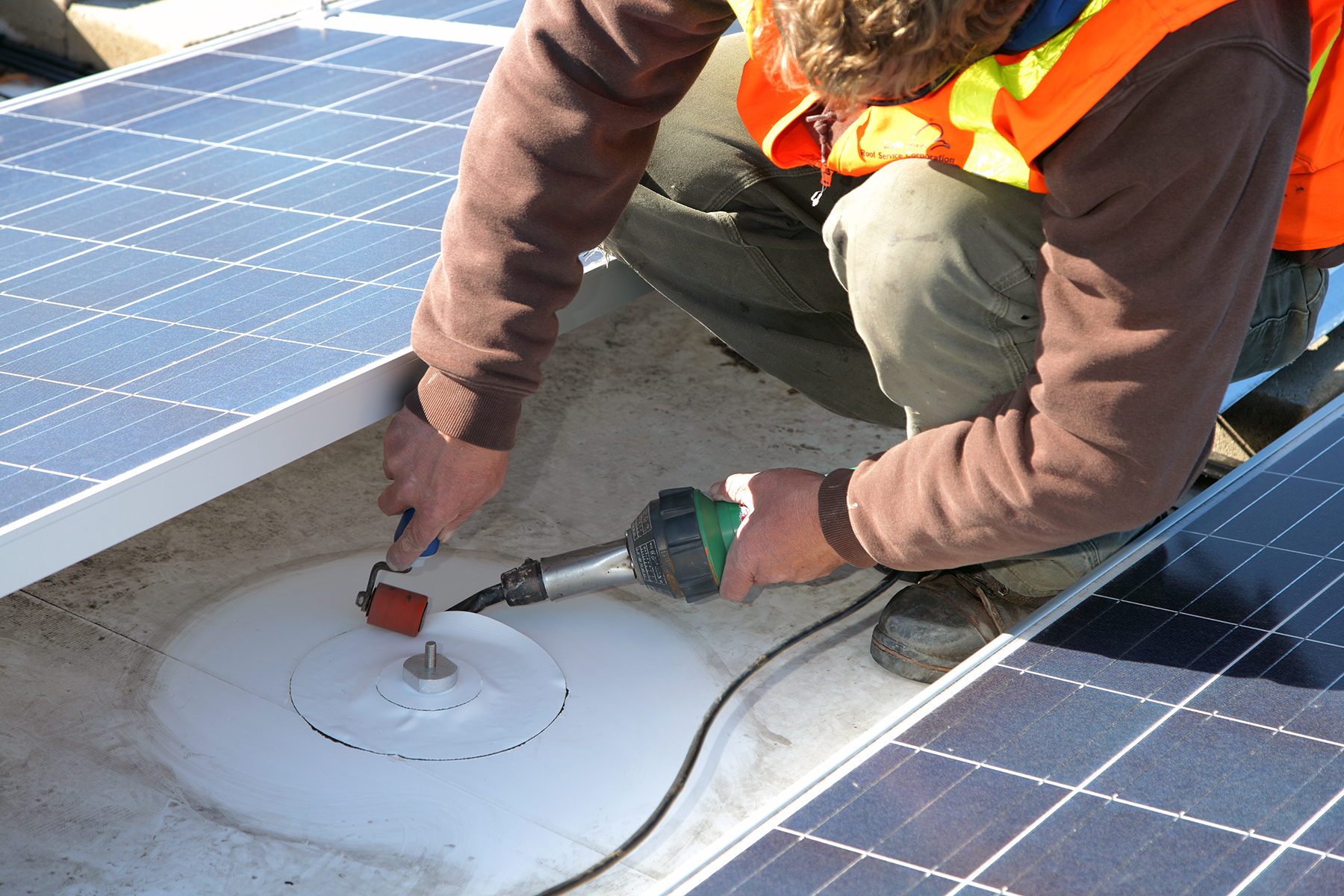
Every rooftop array resolves to one of two attachment strategies, and they create completely different roofing work. A mechanically attached system anchors racking feet through the membrane and into the deck or the structural steel below. On a mid-size commercial array that can be several hundred individual penetrations across the roof field. Each one is a deliberate hole, and each one has to be flashed to the membrane manufacturer's published detail for that exact assembly. Skip that and substitute a hardware-store pipe boot and a bead of sealant, and you have not installed solar, you have installed several hundred future leaks on a predictable schedule. A ballasted system takes the opposite trade: it holds the array down with concrete ballast blocks and avoids penetrating the membrane at all, but every pound of that ballast is dead load the existing structure now has to carry on top of everything else it already holds.
Choosing a Membrane That Can Live Under Panels
The membrane is not a neutral surface once an array goes on it. We favor reflective TPO or PVC under Spokane arrays because the cooler surface marginally helps panel output, resists the scuffing of installation and future module service, and holds up to walkway loads better than a darker sheet. The bigger issue is what the array does to water. Panel rows reshape how the roof drains, creating new channels between racking lines and concentrating runoff at the array perimeter, and the panels themselves shade portions of the field so snow and moisture linger where they used to clear. We design the drainage and the membrane around that reality up front, instead of letting an owner discover ponded water trapped under the modules after the first wet season.
Wind Wants to Lift It, Snow Wants to Crush It
Uplift and gravity load are two separate problems on the same roof, and a solar-ready design has to answer both. Spokane sits at the edge of the Columbia Plateau and takes strong frontal wind events, and a low-slope array is effectively a field of small airfoils waiting to be lifted. A mechanically attached system resists that uplift through its anchors and the pullout strength of the deck; a ballasted system resists it with sheer mass, which means more blocks and more weight. That is where the second problem bites. Spokane carries a substantial ground snow load, and the array's dead weight stacks directly on top of the seasonal snow the structure already bears. Older buildings in particular were framed to lighter load assumptions than current code. We coordinate the structural review so the racking weight, the design snow load, and the building's real capacity get reconciled on paper before anyone fabricates a rack, because a ballasted layout that satisfies wind can quietly overload a roof that was never sized for it.
Where Two Trades and Two Warranties Collide
Most disputes that look like solar problems are actually roofing-warranty problems wearing a solar costume. A single-ply manufacturer will void a no-dollar-limit warranty the moment an unapproved party penetrates the roof or sets racking against the published spec. The solar installer warrants the array's output and its mounting hardware, not the watertightness of the membrane around it. So when water shows up at an interior ceiling, the roofer points at the array and the installer points at the roof, and the owner is stuck in the middle. We eliminate that fight by writing the boundaries down before mobilization: which penetrations the roofing contractor flashes and warrants, which racking and standoff details the membrane manufacturer has pre-approved, what walkway pads protect the field during panel service, and who signs the warranty inspection. Settled in a pre-construction meeting, those questions never become a leak nobody owns.
The Conduit Is Roofing Work, Too
The panels are not the only thing that crosses the membrane. Conduit runs from the modules to the inverters and then down into the building's electrical room, and where that conduit passes through the roof, it is a roofing detail, not an electrician's afterthought. Conduit strapped flat to a membrane abrades it over time, and a through-roof conduit penetration sealed with mastic alone fails within a season or two. We install conduit standoffs and flash every through-roof penetration to the membrane specification before the solar electrician pulls a single wire, so the electrical path never doubles as the water path.
Sequence the Roof First, Then the Solar
The single most expensive mistake in our market is racking a new array onto a membrane with only five to eight years left in it. When that roof inevitably fails, the array comes off, the membrane gets replaced, and the array goes back on, layering tens of thousands of dollars of remove-and-reset labor onto a reroof that was always coming. The discipline that avoids it is deciding early, on evidence. We assess the existing assembly and put a defensible remaining-service-life number on it before any solar contract is signed.
- If the roof has fifteen or more documented years of life, the array can go on as it stands.
- If it is anywhere near the end, we reroof first so the panels land on a substrate that will outlast them.
- Either way, the membrane is installed and inspected before the first piece of racking is set, never the other way around.
- We coordinate the structural review for combined array dead load and Spokane design snow load before fabrication.
- We hold a pre-construction meeting with the solar EPC to assign every penetration, walkway, and warranty signature in writing.
Questions Spokane Owners Ask Before Putting Solar on a Roof
Do we reroof first or install on the roof we have?
It hinges on remaining membrane life. Fifteen or more documented years left, and you install on the existing roof. Seven or fewer, and you reroof first. The cost of pulling an array off during a future replacement almost always dwarfs the cost of replacing the membrane now and racking onto a fresh surface.
Is the array going to put holes in our roof?
Only a mechanically attached one will. Ballasted racking holds the array down with weight and never penetrates the membrane, at the cost of added dead load the structure has to carry. A mechanically attached system penetrates at every foot, and we flash each of those penetrations individually to the manufacturer's detail and keep them inside the warranty.
How do we keep the existing roof warranty valid?
By bringing the membrane manufacturer in before the racking is designed. The major single-ply manufacturers permit solar on a warranted roof when the attachment, walkway protection, and penetration details match their published requirements and a warranty representative reviews the layout. We manage that review as part of the project rather than discovering the conflict after the fact.
Who owns it if the roof leaks once the panels are up?
That is decided in writing before work begins. The roofing contractor flashes and warrants the membrane and the penetrations; the solar installer warrants the array and its mounting. Drawing that line before mobilization is precisely what prevents the finger-pointing that follows most post-solar leaks.
Do you install the solar system itself?
No. We are the roofing side of the project. We assess and prepare the roof, detail and flash every penetration, coordinate the structural and warranty reviews, and work alongside whichever solar developer you choose so the array sits on a roof ready to carry it.